
Students who arrive at UC Merced planning on specific careers often discover along the way that their interests — and strengths — are broader than they first imagined.
A new initiative called Education Tracks, or EdTracks, is designed to give students a flexible, low‑risk way to explore careers in education without delaying graduation or adding significant cost.
EdTracks formally integrates teacher-preparation pathways into existing majors across all three UC Merced schools, such as biology, mathematics, chemistry, physics, computer science and history. The goal is to give students an early, low-risk way to explore teaching while keeping multiple career options open.
“Finding the space and time to put a minor in your degree can be really challenging,” said School of Natural Sciences Associate Dean of Academic Programs Gordon Bennett, a professor of life and environmental sciences. “So we made a whole new framework that clears space and gives students more flexibility to pursue alternative outcomes.”
The effort builds on UC Merced’s CalTeach program. CalTeach has been present at all nine undergraduate UC campuses since 2005 and is focused on preparing undergraduates for careers in education with a particular emphasis on science, technology, engineering and math (STEM). Nearly one-third of California’s single-subject STEM teaching credentials are awarded to UC CalTeach alumni. At UC Merced, CalTeach has long offered minors in natural sciences education, but students often discover the program late in their academic careers — sometimes too late to fit it in.
EdTracks changes that by embedding education‑focused coursework directly into majors, allowing students to test the field as early as their first year.
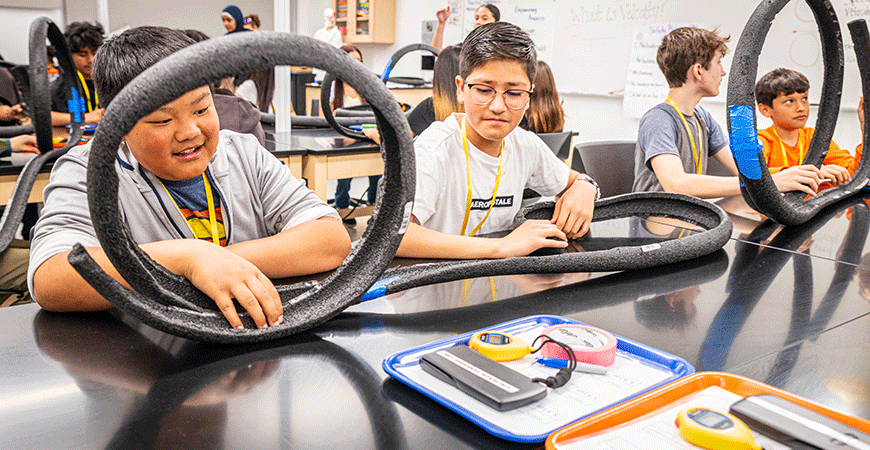
“In all of our CalTeach classes, students are put into the K-12 classroom right away,” said applied mathematics Professor Mayya Tokman. “Even in their freshman year, they are doing fieldwork in local schools.”
The early exposure works both ways, Tokman added. Students who decide teaching is not for them learn that quickly, without spending extra time or money. Those who discover a passion for education can transition seamlessly into advanced pathways.
The structure is simple: Students begin with an EdTrack, which introduces them to teaching methodologies and learning strategies and provides classroom experience. Those courses count toward a natural sciences education (NSED) minor if students choose to continue. There are two options: NSED, which allows students to complete the minor alone or pursue a traditional teaching credential after graduation if they choose; and a natural sciences education minor with credentialing (NSEC), which admits students into a joint program with UC Berkeley that allows them to graduate simultaneously with both a bachelor’s degree from UC Merced and a teaching credential from UC Berkeley.
“The EdTracks are designed so your time to complete NSED or NSEC minor is shortened, and your time to the credential is less expensive or free,” Tokman said.
Reducing cost and debt is a key feature. Through the joint UC Berkeley partnership, credential coursework is now online, rather than requiring relocation to Berkeley, an expense that previously made the NSEC pathway inaccessible to some students. The NSED minor also leads to significantly reduced time and cost of a teaching credential through CalTeach partnerships with UC Merced Extension’s Teacher Preparation Program and other teaching credentialing programs.
“EdTracks reflects exactly the kind of student-centered innovation we value in the School of Natural Sciences,” interim Dean Michael Findlater said. “It lowers barriers, expands opportunity and ensures our students can explore meaningful career pathways without sacrificing time, flexibility or momentum toward graduation.”
These direct undergraduate pathways to careers in education address a statewide need. California continues to face shortages of qualified STEM teachers, and many K-12 educators lack degrees in the subjects they teach.
“If we think about what makes the biggest difference in preparing the STEM workforce, it’s teachers,” Tokman said. “Preparing effective teachers with strong backgrounds in the subjects they teach is crucial for our economy and general well-being of our society.”
Not every EdTrack student will become a teacher — and program leaders say that’s by design. Faculty stress that the skills developed through education coursework have value far beyond classrooms.
“These classes teach you how to learn and how to teach,” Tokman said. “Communication, teamwork, analytical thinking and problem‑solving are exactly what employers are looking for across the job market today.”
Bennett, who once followed a similar education‑focused track as an undergraduate before teaching high school and later entering academia, sees EdTracks as a way to offer students purpose alongside practical preparation.
“Sometimes students ask, ‘What can you do with a biology degree?’” Bennett said. “This provides outcomes that are job‑ready, community‑focused and AI‑proof.”
The Department of Applied Mathematics started offering its EdTracks program this past fall, with biology, chemistry, physics and computer science tracks rolling out next year. The program will appear fully in the course catalog next year, allowing students to opt in earlier than ever. Faculty are also developing a future master’s program in education with specialized tracks.
For students still deciding what they want to do — or who want degrees that keep multiple careers possible — EdTracks offer a new kind of flexibility.
“If you want to become a teacher, that’s great,” Tokman said. “But even if you don’t, this is still a powerful way to grow as a learner and a communicator.”
