
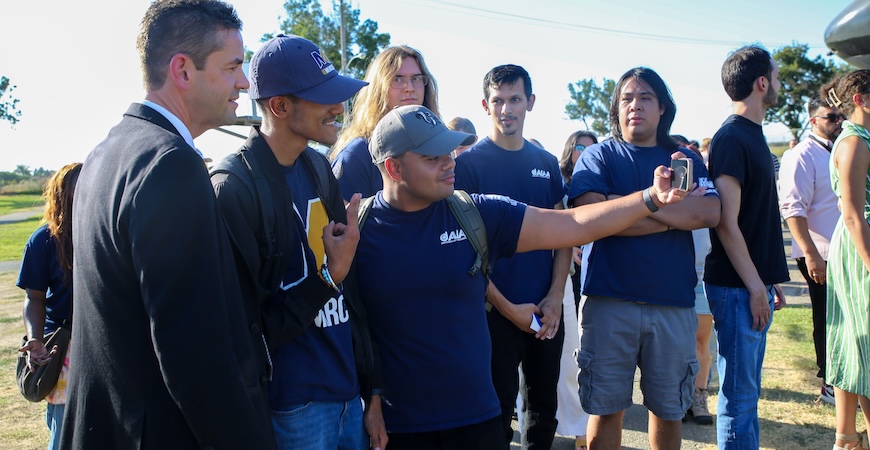
It might seem that an airfield filled with old planes is a strange place to talk about the future of space flight. But Jared Isaacman, the administrator of NASA, said the Castle Air Museum was the perfect setting to talk about what's ahead.
Isaacman visited the former Air Force base last week to tour the planes and talk with students, including a contingent of more than 30 from UC Merced. The group included undergraduate and graduate students, members of the university's first nanosatellite team, and faculty conducting NASA-supported research.
Among the faculty were Vice Chancellor for Research and Economic Development Gillian Wilson, an astronomer and cosmologist, Professor Sayantani Ghosh, an expert in condensed matter physics, and Professor Erin Hestir, a remote-sensing scientist and director of CITRIS, the Center for Information Technology Research in the Interest of Society & the Banatao Institute at UC Merced. The visit followed a stop at the Lawrence Livermore National Lab, where he met with scientists working on some of the technology to launch with Artemis IV, a moon-landing mission planned for early 2028.
"That's just the opening act to America's grand return to the lunar surface," Isaacman said.
But space flight started with subspace flight, and the Castle display includes a F-100 previously flown by astronauts Neil Armstrong and Gus Grissom, the NASA director said in a post on X. "A real piece of NASA and American aviation history."
NASA also was the final operator of the SR-71, a long-range Mach 3-plus reconnaissance aircraft that is on display at Castle.
"We are still doing the airplane thing," Isaacman said. "We are rebuilding our X-plane portfolio and we are doing it here in California … so we can start flying higher and faster just like we did in the good old days."
Rayan Dua, a computer science and engineering major and member of UC Merced's American Institute of Aeronautics and Astronautics (AIAA) student chapter, was among the students invited to meet with Isaacman. Dua is a member of the BOBSat-1 team, which is designing UC Merced's first nanosatellite. Led by Hestir, BOBSat-1 is a collaboration between the AIAA student chapter and CITRIS at UC Merced.
"We got to hear about what NASA is currently working toward, including returning humans to the moon, developing the technologies and infrastructure needed for a more permanent presence there, and advancing future human spaceflight, science and aeronautics," Dua said. "We were also able to share some of the projects we are working on at UC Merced. It was especially interesting getting to speak with Administrator Isaacman directly and learn more about what his day-to-day work at NASA looks like and what goes into leading an organization of that scale."
Fellow computer science and engineering major and BOBSat-1 team member Samir Ahmed said he talked with Isaacman about "what it felt like to complete the first civilian spacewalk and the sense of duty he returned with to continue pushing the boundaries of human exploration. He likened it to the ocean explorers of the 1400s, who ventured into waters without knowing what was out there, but pushed forward driven by curiosity and a desire to discover what lay beyond the horizon."
Isaacman told the students that the new era of space exploration will create jobs in multiple sectors.
"This whole space thing is not going to be limited to pilots," he said. "Whether you want to go to the moon, whether you want to build the hardware that goes to the moon … all of these things are in the realm of possibility."
He told the students, "You couldn't be growing up and contributing to this adventure at a better time in the history of America's space program."
For Ahmed and Dua, that message resonated in particular ways: through BOBSat-1, UC Merced students are already gaining hands-on experience designing spacecraft systems and working through the technical challenges of a real satellite mission.
Ahmed and Dua both said the experience was inspiring and expressed gratitude to Hestir. who leads several NASA-supported research efforts and serves as principal investigator for BOBSat-1, coordinated UC Merced's participation in the visit. "It was a great reminder of the impact that research and exploration can have beyond the lab," Ahmed said.
Added Dua, "Getting to meet the NASA administrator and have an actual conversation with him was something I definitely did not expect to experience this early in college."
For students already helping design UC Merced's first nanosatellite, the visit offered a glimpse of where that work could lead.
